I collect gadgets. If it beeps or boops, I probably have one. Call it an overcorrection from a childhood where video games were forbidden.
Over the years, I started to collect Pocket Operators:

Pocket Operators are handheld synthesizers/drum machines, made by Teenage Engineering. They resemble calculators, if calculators beeped, booped, and lit up themed scenes across a simple LCD.
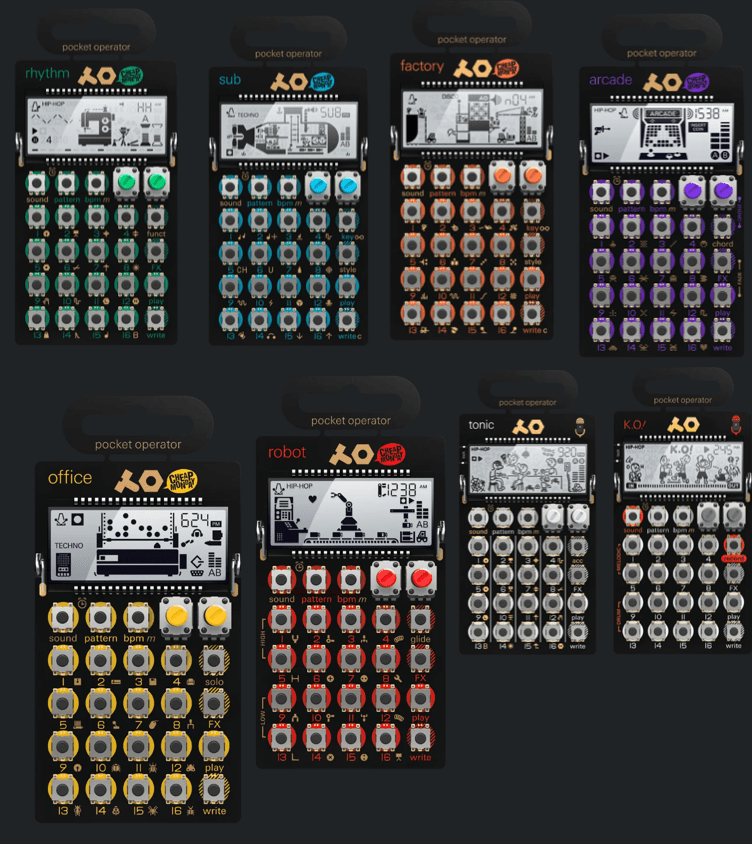
I’m always seeking dedicated-purpose phone replacements, particularly when traveling. The fragility of bare PCB make Pocket Operators a fun but nerve-wracking tool for music on the go.
While flying, I travel with my PO-33 K.O. I pass the time programming beats instead of refreshing email. I record a boarding announcement using the built-in mic, and remix to my heart’s content.
Pocket Operators draw attention for their curious form factor. Inevitably, bystanders ask: how much does it cost?
The answer: More than you probably want to pay.
So, why does such a simple machine cost as much as $99?
To the musical types in your life, Pocket Operators are a charming novelty, Whether or not it’s worth adding a Pocket Operator to your life or workflow depends on your budget, production needs, and creative desires.
As a general rule, if you’re making an investment into new music gear, you should know what it does, and what you’ll do with it.
I did not do this.
When I first got my PO-15 and PO-33, I spent more time on YouTube and reading knowledge bases than making music.
Pocket Operators come with a quick-start guides that do their best to beat down the learning curve. Still, without a basic understanding of music production terms, you’re running off to Google to understand what step sequencer sync modes are.
The PO-33 K.O!’s product page boasts the following benefits:
- studio quality sound
- microphone for sampling
- 8 melodic sample slots
- 8 drum slots
- 40 seconds sample memory
- 16 effects
- step multiplier
Your mileage may vary on how much you understand these terms. What’s a step multiplier? What’s a sample slot?
My PO-14‘s features are even more mystifying to the uninitiated:
- multiple real synthesizer engines
- 15 sounds + micro drums
- 16 punch-in effects
- 16 punch-in bass oriented play styles
- 16 pattern chaining
Oh OK. I didn’t realize you gotta look out for artificial synthesizers.
A Pocket Operator’s compact controls rely on function layers to carry out its work. Memorizing these functions takes time. Quick-start guides, cheat sheets, and tutorial videos abound online as much as loops, songs, or samples created with these synthesizers.
It can be tempting to try and collect ’em all, but there is plenty of free software available for those wishing to dabble in synthesizers.
Despite the relative fragility, high cost, and steep learning curve I experienced, I still love my Pocket Operators. I’ll love them even more once I fully crack the code of how to use them.
Darlene
 Darlene ChaniMaya Postma
Leave a comment